By Portrait Gift Team | July 22, 2026 | 4 min read
Most couple portrait poses fail for the same reason: two people standing side by side like coworkers at a conference. Here are the poses that reliably flatter — for a camera or a painted portrait — plus the fixes for stiff hands, height gaps, and forced smiles.
Most couple portraits fail in the same way: two people standing shoulder to shoulder, arms straight down, smiling like coworkers at a conference booth. The fix is rarely a fancier camera or a better location — it's a pose that gives you both a point of contact and something to do with your hands. This guide covers the poses that reliably work, the small adjustments that unstiffen almost any photo, and a third option most people don't consider: a painted portrait, where the pose comes from the scene and nobody has to perform in front of a lens at all.
Awkward couple photos share two ingredients: no physical connection, and hands with nothing to do. Fix both and nearly any arrangement works. Rule one — one point of contact, minimum. A hand on a shoulder, foreheads touching, an arm around a waist: contact is what makes two individuals read as a couple. Rule two — every hand gets a job. Holding the other person, tucked in a pocket with the thumb out, adjusting a collar. A dangling hand is the single most common tell of a posed-and-uncomfortable photo.
Forehead-to-forehead. The most reliable pose in portraiture: eyes closed or lowered, a slight smile. It works because nobody has to look at the camera, which is where most self-consciousness lives. The walking hand-pull. One of you leads, glancing back; the other follows, laughing. Motion forgives everything — mid-step photos never look stiff. The seated lean. One seated, one standing or perched behind with an arm draped over the shoulder. This is the pose to reach for when there's a height gap, when one of you is camera-shy, or for older couples who want dignified over cutesy. Back-to-back. Equal billing, both faces to the camera, arms crossed or hands clasped behind. It reads playful-confident rather than romantic, which is exactly why it works for couples who cringe at the soft stuff.
Whatever the arrangement: bring chins slightly forward and down (it defines the jawline on everyone), angle bodies toward each other even when faces point at the camera, and solve height gaps with geometry — someone sits, leans against a wall, or stands a stair-step behind — never with tiptoes. Shoot or pick photos in soft light: open shade and overcast days flatter; noon sun carves shadows under eyes. And take three frames of everything, because the second one, after the nervous laugh, is usually the keeper.
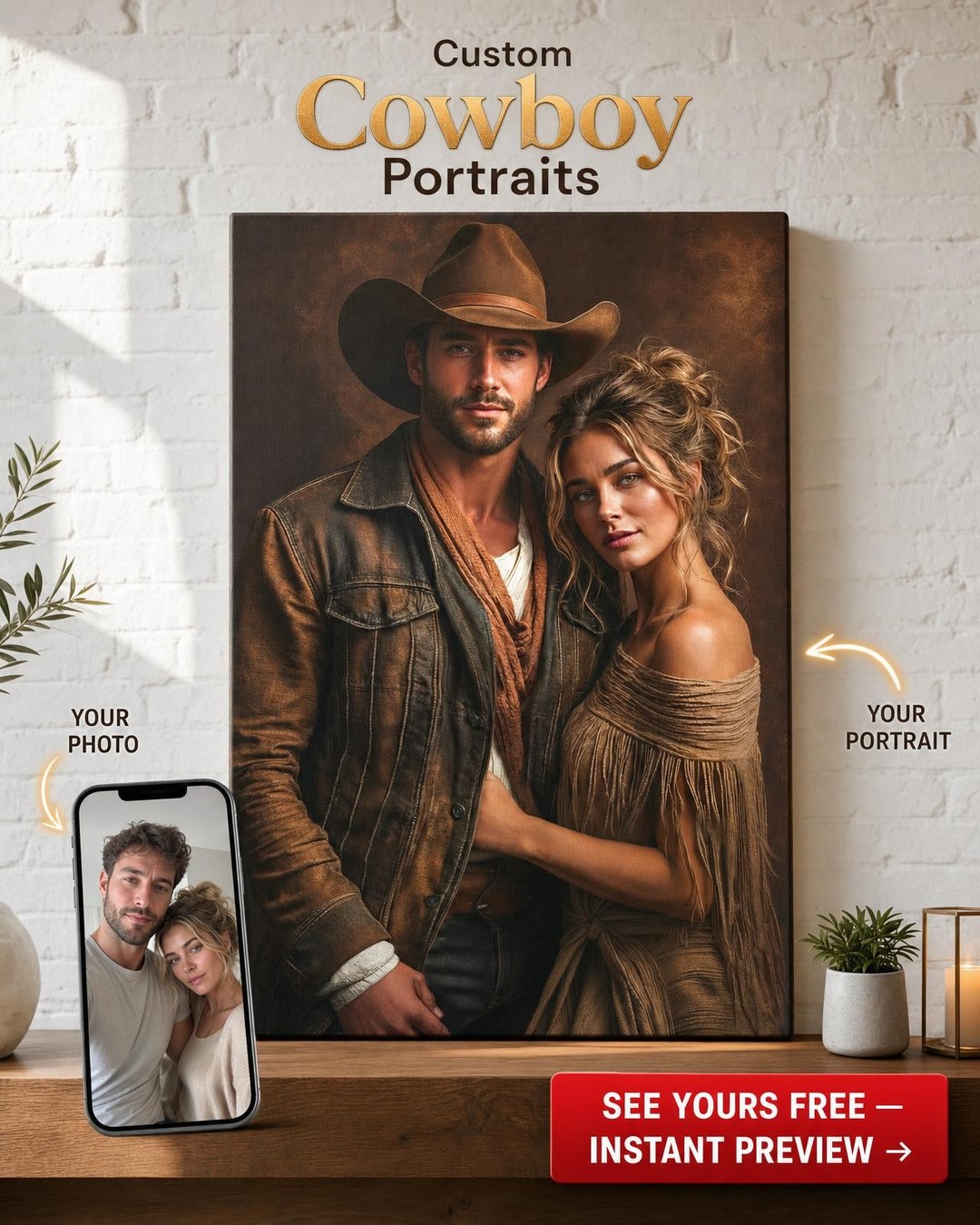
Here's the option that changes the question entirely. In a custom painted couple portrait, the pose belongs to the scene you choose — dancing in a ballroom, back-to-back in Viking armor, side by side on thrones, a western dip at sunset. Your photos contribute only the faces, painted into figures that are already posed perfectly. That means the "pose ideas" search becomes a browse: the couple portrait collection is effectively a catalog of finished poses with the faces left blank for yours. It also removes the requirement that trips up most surprise gifts — you don't need a good photo of you together, because each face is painted from its own separate picture.
For a painted portrait, photo choice matters more than pose, because the photo is where the likeness comes from. The rule covers ninety percent of cases: each face sharp, front-facing or close to it, and unobstructed — no sunglasses, no heavy shadow across the eyes, no group shot where a head is fifty pixels wide. Expression-wise, relaxed beats staged; the scene supplies the drama so the face doesn't have to. The full checklist, with examples of photos that do and don't work, is in our guide on how to choose a photo for a custom portrait.
If you're deciding between moods — romantic, heroic, funny, formal — the portrait pose ideas explorer lets you compare poses across themes side by side before settling on a direction. And for a painted portrait, the decision never has to be made on imagination alone: upload a photo of each of you, pick a scene, and look at the actual result. The preview is free and comes before any payment — so if the throne scene turns out stiff and the dance dip turns out perfect, you'll know in minutes, not after it's hanging on the wall.
Forehead-to-forehead is the safest bet across ages, heights, and comfort levels: it creates an obvious point of connection, gives both faces a natural angle, and works whether the couple is twenty-five or seventy. If one of you hates being close to a camera, the seated lean — one seated, the other resting an arm on their shoulder — flatters almost as reliably with half the intimacy pressure.
Give every hand a job and create one point of contact — those two rules fix the vast majority of stiff couple photos. Hands hold each other, rest on a shoulder, or sit in a pocket with the thumb out; never dangle. Then add motion: walk toward the camera, lean in mid-laugh, adjust a jacket. A pose caught between movements reads as natural because it is.
Coordinate tones without matching outfits — two people in identical white shirts read as a uniform, while one patterned and one solid piece in the same temperature of color read as a couple. Avoid large logos and busy prints that pull the eye off your faces. And if the portrait will be painted into a themed scene, wear anything at all: the costume layer is painted in over whatever was in the photo.
Yes — in a painted couple portrait each face comes from its own source photo, so the two pictures can be from different years, phones, and lighting. This is what makes surprise anniversary portraits practical, and it also means long-distance couples, or a portrait including someone who has passed away, need no photo of the pair together.
No. The painting borrows only the faces, so a phone snapshot works exactly as well as a studio shot — what matters is that each face is sharp, front-facing or nearly so, and not covered by sunglasses or heavy shadow. A relaxed photo from a dinner or holiday usually produces a better likeness than a posed one, because the expression is real.