By Portrait Gift Team | July 21, 2026 | 4 min read
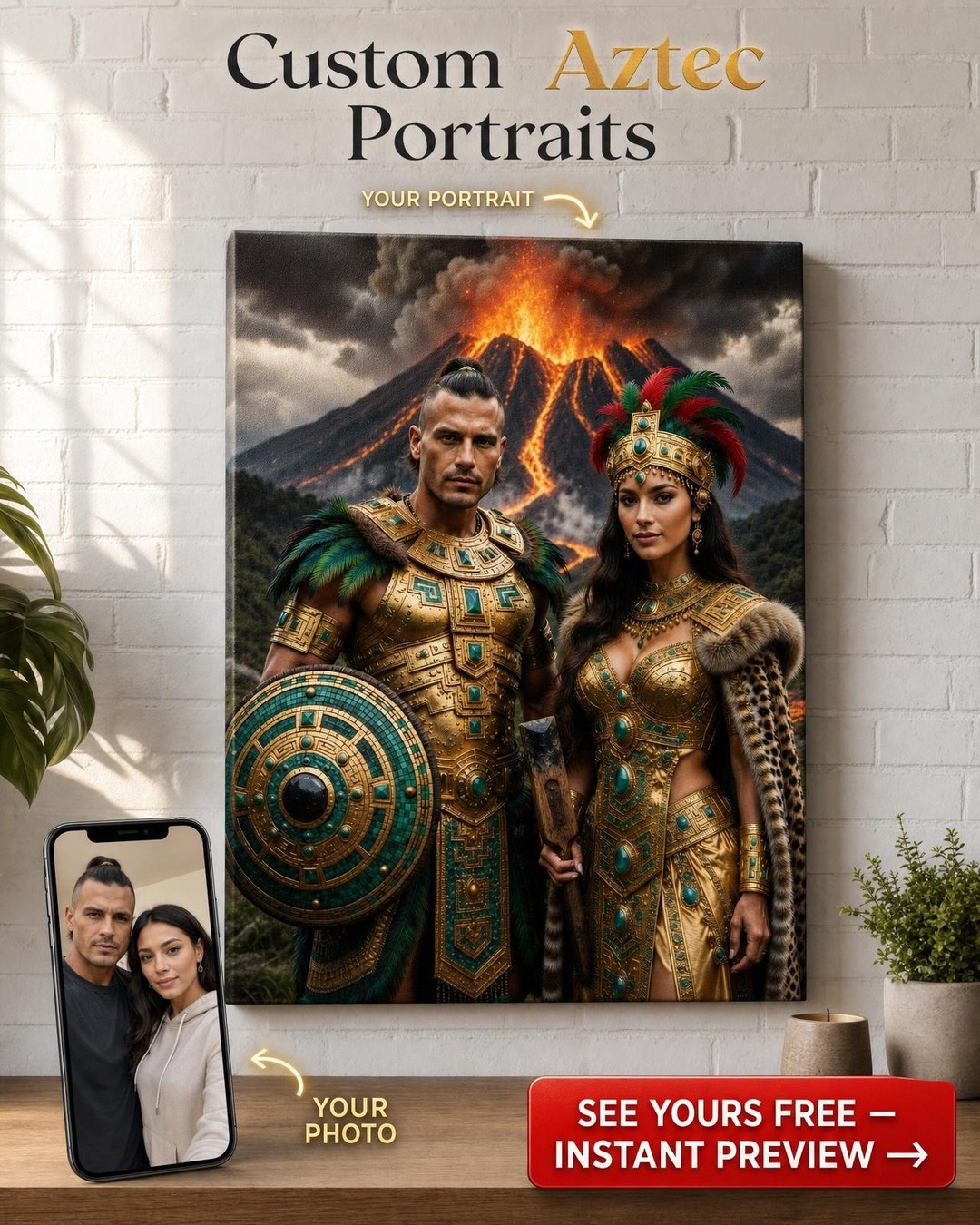
You don't need a feathered headdress or a temple backdrop to end up in an Aztec portrait — you need one clear photo and a scene that fits the person. Here are the warrior, queen, and couple scenes that get ordered again and again, and how to choose the photo that keeps the likeness.
Most Aztec portrait ideas you'll find online are aimed at photographers and cosplayers — build a headdress, find golden-hour light, hold a spear convincingly. None of it applies to a custom portrait, because nobody poses for one. You choose a finished scene, send an ordinary photo, and the face is painted into the regalia. That changes the real question from "how do I look Aztec in a photo" to "which scene fits this person" — and that question is worth a few minutes, because the scene decides whether the portrait reads as heroic, regal, romantic, or proudly ancestral.
In a painted Aztec portrait the stance, the weapon grip, the tilt of the feathered headdress — all of it belongs to the scene design. Your photo contributes the face and nothing else, which is why "I don't have a photo that fits" is never the obstacle people expect it to be. It also means you can shop for ideas the way you'd shop for finished art: the Aztec portrait collection is effectively a catalog of scenes that already work, each waiting for a face.
The men's scenes cluster into two moods. Heroic: an eagle or jaguar warrior — the two great Mexica military orders — in feathered or spotted regalia against stone and sky, the default pick for husbands, brothers, and sons. Serene-commanding: a calmer chieftain figure, gold and jade rather than weaponry, which suits fathers and grandfathers who would find a battle scene faintly ridiculous. If he laughs at the idea of himself in a headdress, that's not a warning sign — the portraits that get laughed at on unwrapping are the ones that end up on the wall.
The women's scenes split the same way. The regal direction — a feathered queen with a jade collar and gold cuffs, painted like nobility — is the one most often chosen as a gift for mothers. The warrior direction puts her in the same eagle-warrior lineage as the men's scenes: fierce, armed, and emphatically not decorative, which is why it's usually chosen by the woman herself. Both take the identical kind of source photo, so the choice is purely about which version of her belongs on the wall.
Couple scenes are where the theme does something a solo portrait can't: two people rendered as equals in matching regalia — paired warriors, or a crowned pair in gold and jewels. Because each face is painted from its own photo, there's no need for a good picture of the two of you together, which quietly makes this one of the easier anniversary surprises to arrange in secret. If you're weighing the couple designs specifically as a gift, the roundup of personalized Aztec couple gifts compares the popular ones.
A large share of Aztec portraits are ordered not as fantasy but as heritage — a way to put a parent or grandparent of Mexican descent into imagery drawn from Mexica iconography: the military orders, the featherwork, the monumental stone of Tenochtitlan. The scenes are built as celebratory, heroic portraiture rather than costume parody, and that's precisely why the reaction to unwrapping one tends to be quieter and longer than the reaction to a gag gift. If the gift is meant this way, lean regal rather than battle-ready.
One rule covers nearly everything: the face should be sharp, front-facing or close to it, and unobstructed. Skip sunglasses, brims that shadow the eyes, and group shots where the head is fifty pixels wide. Everything else — background clutter, pajamas, an unfortunate haircut — never enters the painting. A relaxed expression outperforms a staged stern one; the regalia carries the drama so the face doesn't have to. And if you're still deciding between this theme and another, the portrait pose ideas explorer lets you compare scenes across every style before committing.
The scene question doesn't need to be settled by imagination. Upload the photo, pick the eagle warrior or the feathered queen, and look at the actual result — the preview is free and comes before any payment. If the fierce photo turns out awkward or the regal scene turns out perfect, you'll know in minutes rather than after delivery. The gold, the feathers, and the stonework are already painted. All that's missing is the face.
No — the headdress, feathers, gold, and temple backdrop are all part of the scene design you choose. Your photo contributes only the face, so an ordinary picture from a family dinner works exactly as well as anything staged. Everything below the chin is replaced by the painted scene.
The warrior scenes are the reliable picks: an eagle or jaguar warrior with an obsidian-edged weapon reads as heroic without needing any inside knowledge of his taste. For fathers and grandfathers, the more regal chieftain-style scenes tend to land better than full battle scenes — commanding rather than costumed.
Yes. Each person in a couple scene is painted from their own separate photo, so the two pictures can come from different phones, different years, and different lighting. The scene is what places you side by side; the photos only need to show each face clearly.
The scenes are built as celebratory, heroic portraiture — regal dress, warrior regalia, monumental backdrops — rather than costume parody, which is why so many are ordered as heritage gifts for parents and grandparents of Mexican descent. If a scene matters to you for family reasons, the free preview lets you judge the result before any payment.
A sharp, front-facing photo with the face unobstructed — no sunglasses, no heavy shadow across the eyes, no group shot where the head is tiny. Background, clothing, and haircut are irrelevant because they never enter the painting. A relaxed, natural expression works better than a deliberately fierce one; the regalia supplies the drama.